Identity
Person No.
29295
Old ROH no.
34807
Service No.
Unknown
Last Name
First Name
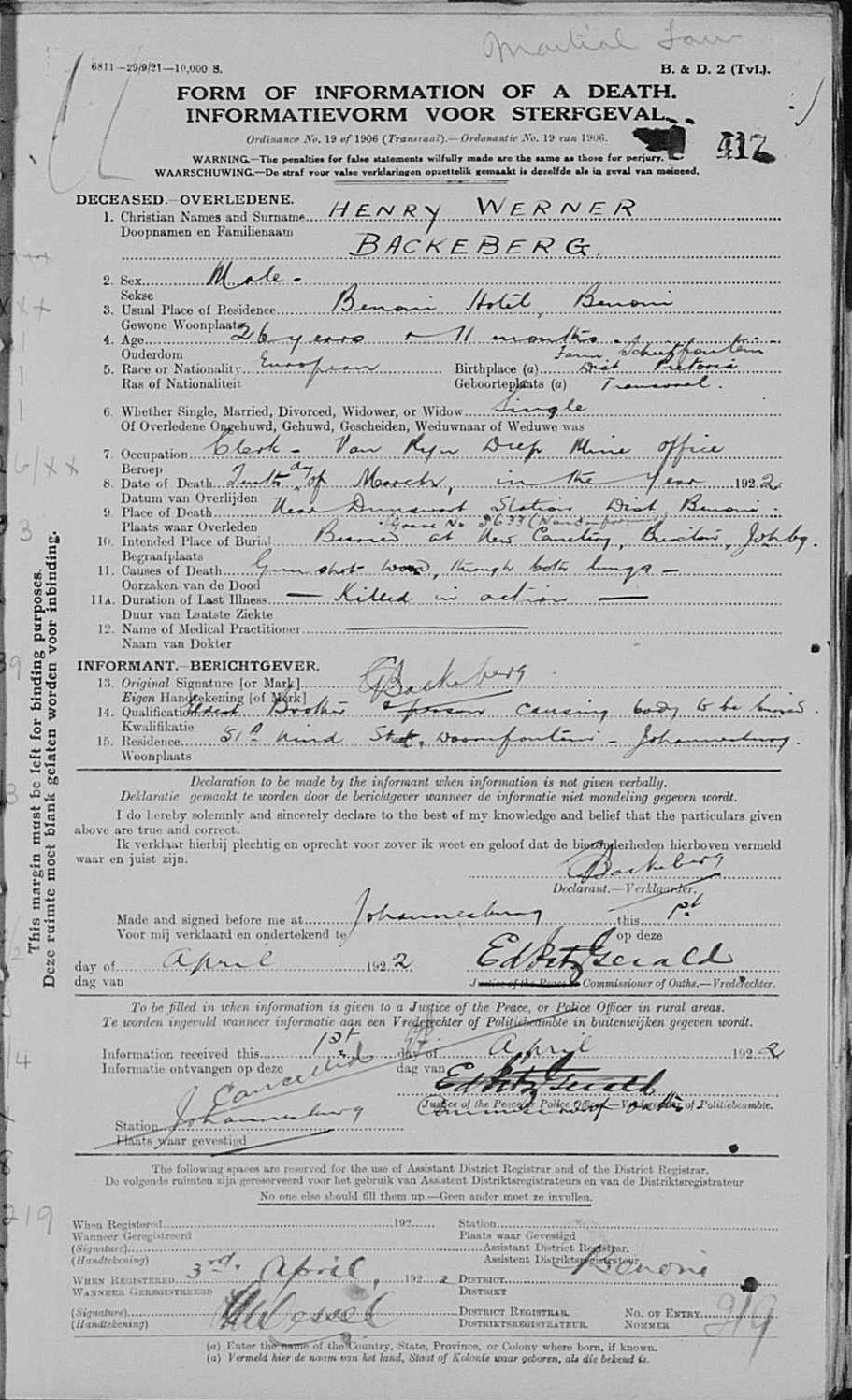
Henry Werner
Initials
H W
Date of Birth
Unknown
Est. Birth Year
Age at Death
26
Death Record
Date of Death
Cause code
KIA 14,780
Killed in action
Military Service
Location
Country
Locality
Cemetery
Grave Reference
Coordinates
Unit History
Role at time of death
Infantry
Status
Active Citizen Force (Reserve)
Part of
Transvaal Scottish, formed 1902 after the Second Anglo-Boer War. Active Citizen Force infantry regiment through WWI, WWII (2nd/3rd Bns raised 1936/1939) and the Border War. Renamed Solomon Mahlangu Regiment 2019. Needs further research to break out exact era boundaries/role changes (e.g. 1953 and 1997 battalion amalgamations) as sources are found.
Notes
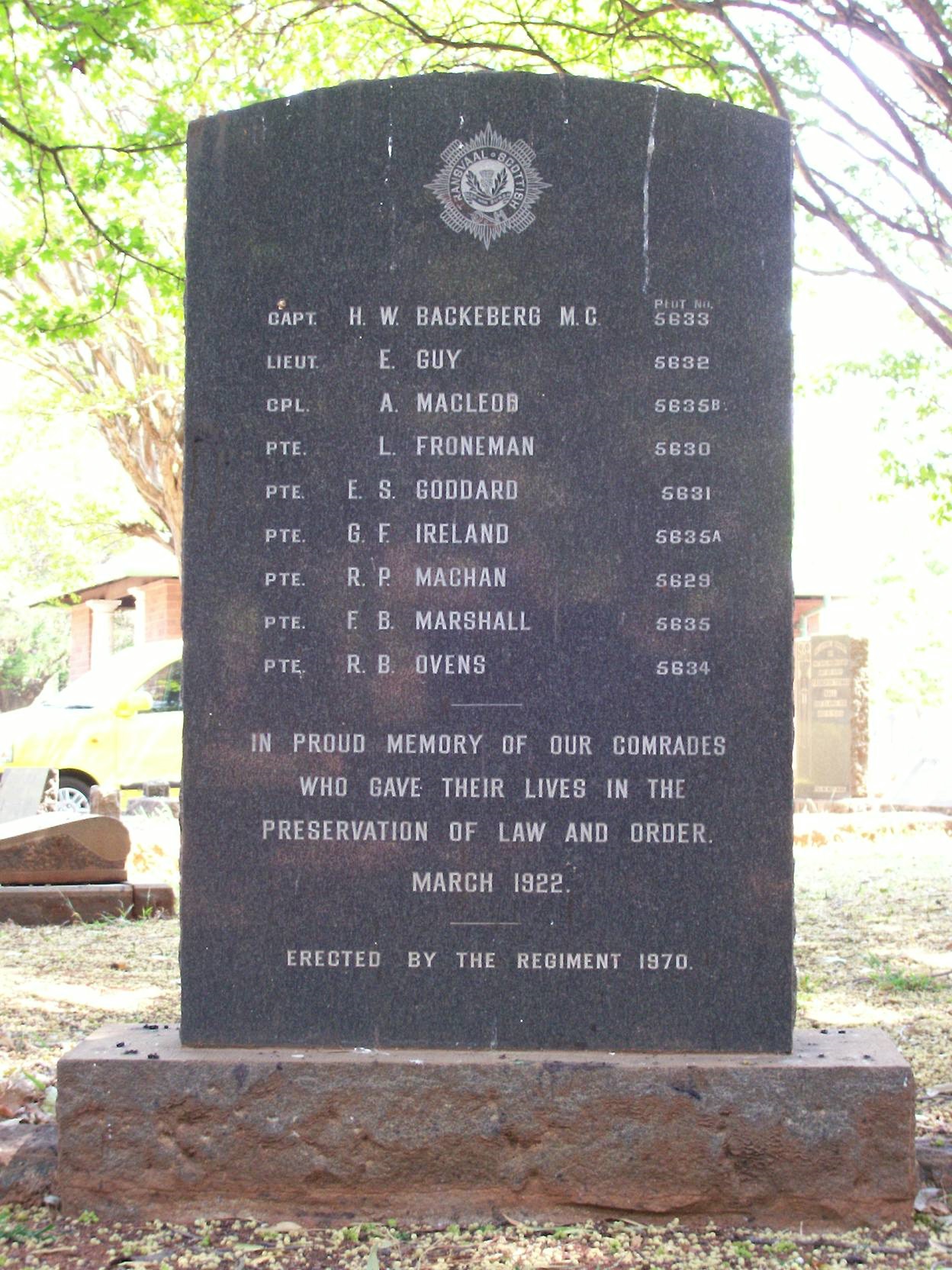
A clerk
Citations
LG Sup 16 Sep 1918 pg. 11055 - "For conspicuous gallantry and devotion to duty. He showed great judgment in his handling of men. He went forward under heavy shell and machine-gun fire to try and establish communication with other troops. By his cool bearing and splendid leadership he set a fine example to the men under his command"

External References
Stories 1
Lieutenant Backeberg , were killed by strikers concealed in the leafy branches of surrounding trees. I remember hearing as a small boy, from Captain McCalgan, who was in charge of the party that Bertie was stuck by a keyholing bullet in the side and that he took some 20 minutes to die, his last words being, “Christ Mac, it hurts”. His last minutes were eased by Private Willy Crowe, who was employed at the Eclipse Engineering Company in Benoni until the 1970’s, some 50 years later and a condition of his employment, insisted upon by my father, Augustus Henry Guy, when he retired, was that Willy should be kept on until he left of his own accord. When I last saw him in 1971 he was driving a gantry. A direct result of the cost of living was the strike of 1922, which started in January 1922, on the coal mines. It spread to the gold mines and at some time between January and March the movement was converted into an attempted conversion to a communist takeover. It was an exciting time particularly the first days of March. Father was an official and consequently not a striker and rumours came and went with the wind; trenches and shelters were dug, weapons brought out and refurbished and African labour was turned into all sorts of work. I remember that we on West Rand Consolidated got a swimming bath dug; in those days it was at the club house and the bones of scores of cattle were dug up, said to be the remains of cattle who had died in the rinderpest. At last, in late February, there was sporadic shooting along the Reef and Dr. Woodrow Watt volunteered to go into Johannesburg to find out what was happening. This was before the Main Reef road had been tarred so it was a bumpy dusty drive. It must be remembered that the war had only ended four years previously and thus there were large numbers of men available, trained in the use of arms and explosives. Trains and powerlines were dynamited and it was finally necessary to call out the troops: with their arrival, the first being the Durban Light Infantry , the shooting started in earnest, and among those called up was my uncle Bertie. Bertie Guy had come through the war unscathed and he had joined the Transvaal Scottish mainly for its social position. Woody Watt brought back news that all units of the Active Citizen Force had been called up, including the
Dedications
No dedications have been added yet.